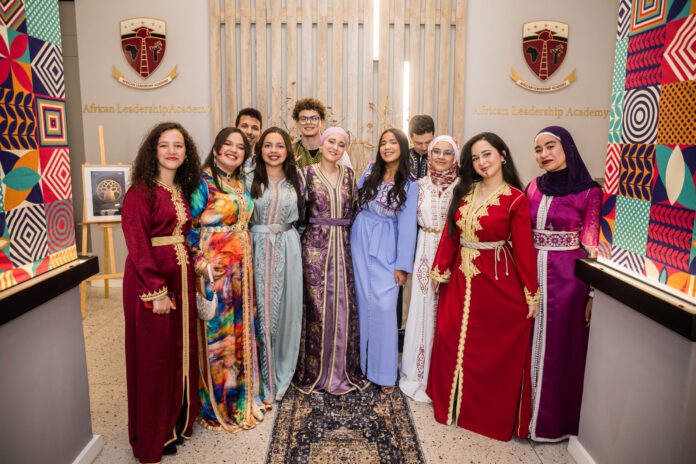
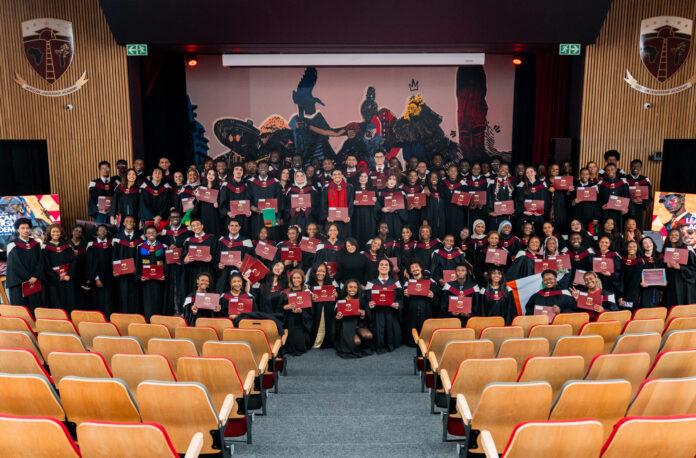
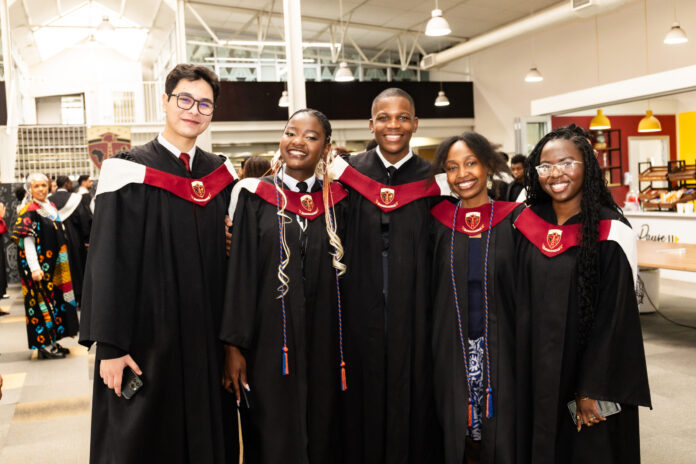
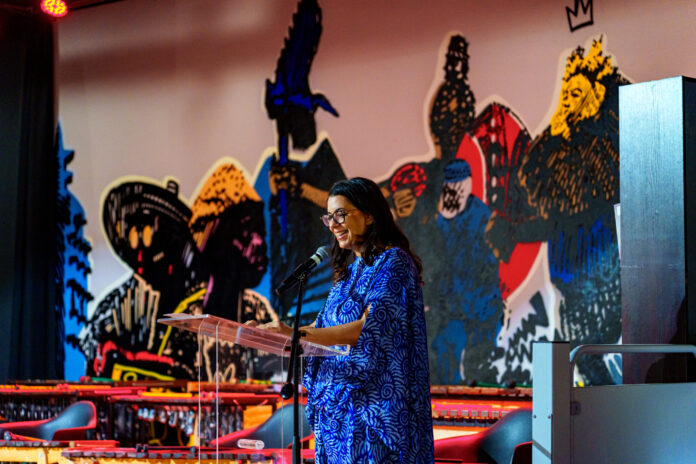
At Taalu 2025, ALA’s annual gathering that celebrates unity and purpose, Student Government Chairs Ajibola Balogun ’24 (Nigeria) and Ayira Browne ’24 (Kenya) stood before the community with a simple but powerful theme: Find Your Why. They urged everyone to pause and think about what truly connects us. Their message moved beyond familiar ideas of Pan-African unity, inviting each person to look inward, to define their own purpose, and to consider the part they play in Africa’s unfolding story.
Read their full speech below and take a moment to reflect on your own why.
Find Your Why
How many of you here would say you are Pan-Africanists?
Feel free to raise your hands. Don’t be shy.
Wow. A lot of you. That’s not surprising—after all, look at where we are.
ALA. The African Leadership Academy.
A place where the air is thick with purpose. Where the walls themselves reverberate the words “the next generation of African leaders.”
A place where we believe in something greater—something united.
Pan Africanism
a vision of unity where all people of African descent, all indigenous and all diaspora hold hands in solidarity and then and only then, are we strong enough to fight our common struggles and champion our common interests.
Oh what a world
But there is a truth we don’t always like to say out loud:
Pan-Africanism is a dream.
And as unfortunate as it may be, that is sometimes all Pan-Africanism can be—a dream.
A series of thoughts, images, and sensations occurring in a person’s mind fit for sleep.
Never quite to come to fruition.
Because a dream is not a plan.
A dream is not a strategy.
A dream is not a solution.
Now… look at us.
Look at all of us, today, on this day of Taalu.
Smiling. Dancing. Celebrating.
Wrapped in the indigos of West Africa, the lion hides of the South, the beadwork and reds of the East, the gold and weaving textures of the North.
We gather with our different languages, our different names, our different homes—united under one roof, told we are the next generation of African leaders.
And perhaps, in moments like this, we begin to believe it.
That there’s something sacred about this kind of unity. This gathering. This energy.
But in the same breath, there’s something strange, almost paradoxical, about it too.
Because the moment we all sit together in this unity…
What appears most clearly—is our difference.
And I don’t mean that as a bad thing. Because as i’m sure we all know more two things can be true at once
Because In fact that difference, I believe that’s the most powerful part of it.
Unity is not the absence of difference.
It’s the recognition of it. The embracing of it. The choice we all make to stand together, not despite it, but because of it.
Still, this idea of unity… this dream of “oneness”… it is not new.
It’s not unique to ALA.
In fact, it’s the foundation of our foundation – Pan-Africanism.
But as I have alluded to previously Pan-Africanism, if we are all being honest, is not always grounded in reality. In fact its not always grounded in our reality.
See, early Pan-Africanists imagined a kind of pre-colonial African utopia for us to return to—a unified, communal society where all Africans lived in harmony.
But that version of history never existed.
Yes, Pre-colonial Africa was filled with vibrant cultures but also rivalries, wars, and deeply rooted differences in politics, language, and religion.
To imagine a united Africa as something we “once were” is to look at our past with rose tinted glasses. Lenses that then blur where we are and the path we are taking.
It’s a unity that’s emotionally compelling, but largely historically false.
And worse—it risks becoming intellectually lazy.
Because if unity is our only solution, then what exactly are we uniting around?
Why Africa?
Why not an African-Indian union? Or an African-Latin American one?
India too was colonized, divided, stripped of its language and economic autonomy.
The struggles that define ‘the African experience’
So i ask you Why not unite with India?
Even looking at Pan-Africanism, the idea itself was not born on this continent. It was born in the diaspora.
In the pain of slavery, segregation and systemic racism against all those of African descent, rose a struggle to find identity
And the unity they found was in their Blackness—that made sense.
But when that idea was projected onto the continent, it didn’t quite translate.
Because the experience of a Ghanaian is not the same as that of a Somali.
A Namibian does not live the life of an Algerian.
And even, the similarities that we all call upon as the reason to unite are unique to Africa.
So it becomes quite clear We are not one Africa
the dream, our dream becomes confusing, it starts to falter.
Because it never asks us:
Why?
Why do we want this unity? Why Africa?
And without that “why,” we’re left clinging to sentiment.
And sentiment will not save us.
Now… let’s talk about ALA.
Because if we’re really listening…
Doesn’t some of this sound a little too familiar?
ALA too can feel like a dream.
An institution that believes it can prepare students—just two years of curriculum, fellowship, and networking—to go out and “transform the continent.”
And students who believe ALA can prepare them to go out and transform the continent.
Almost as if Africa’s problems were homogenous.
As if we all lead the same Africa.
And the truth is: in many ways ALA inherits the same romanticism as Pan-Africanism.

The belief that by gathering young minds from across the continent, we can somehow create the singular blueprint for Africa’s future.
But Africa does not need a blueprint.
Africa is a story that keeps telling many stories.
And the danger of any one institution—especially one as powerful and well-branded as ALA—is that it begins to believe its story is the story.
And though the similarities between Pan Africanism and the mission of this institution are undeniable.
A key difference exists.
There is a reason ALA is more than a fading dream.
Pan-Africanism, perhaps, has run its course.
But ALA is still running, still becoming.
ALA is alive.
And why?
Because we are alive in it.
ALA is not fixed. It cannot remain rigid and I say this regardless of what this administration may perpetuate. We are built to evolve
It is shaped—daily—by how we live it, how we love it, how we grow through it and how I hope it will challenge it.
We—students, teachers, staff, guards, cooks, —we define what ALA is.
And I know without doubt that it is not a monument. It is a movement.
So when you feel like ALA isn’t perfect, good. That means you’re paying attention.
But never forget: it’s not supposed to be perfect.
It is supposed to be possible.
And the possibility of ALA lives in each of us.
So today, on this beautiful day of Taalu, in your beads and wrappers and wax prints, I’m asking you to feel more than proud.
I beg of you
Ask yourself: Why?
Why unity?
Why ALA?
Why Africa?
Because When we leave this place—and we will all leave , when we scatter across the globe like seeds thrown into the wind…what will draw us back?
What will hold us when our world feels too heavy and it seems we’ve grown?
What will remind you of who you are?
It will be your why.
That thing you cannot always explain but you always feel.
The reason you keep choosing Africa
It will be the reason you return.
Let it ground you
Because we cannot deny that this unity before us is beautiful.
I just wonder why
Thank you